Continuity of Operations

Continuity of operations is a collective planning process to continue our institution’s essential functions during a disruption.  Continuity takes time, commitment, and forethought…and is NOT guaranteed.  It is an ongoing process that requires support from senior leaders and dedication from subject matter experts across campus.
The Continuity of Operations Plan (COOP) instructs UMBC Colleges, Divisions, and subordinate units how to identify essential functions and the actions necessary to ensure continuous performance during disruptions.

Business Continuity is a method of documenting your individual and unit-level responsibilities.

  • Business Process Analysis (BPA) Worksheet (v1.4) May 2026.  This is a systematic method of mapping each organizational work function.
  • Organizational work functions are your primary day-to-day activities that may or may not be essential for Continuity of Operations.
  • The BPA process allows leaders to determine which functions are essential and helps subject matter experts document and validate institutional knowledge.
  • Utilize job descriptions, performance reviews, and policy or regulations to describe organizational work functions.

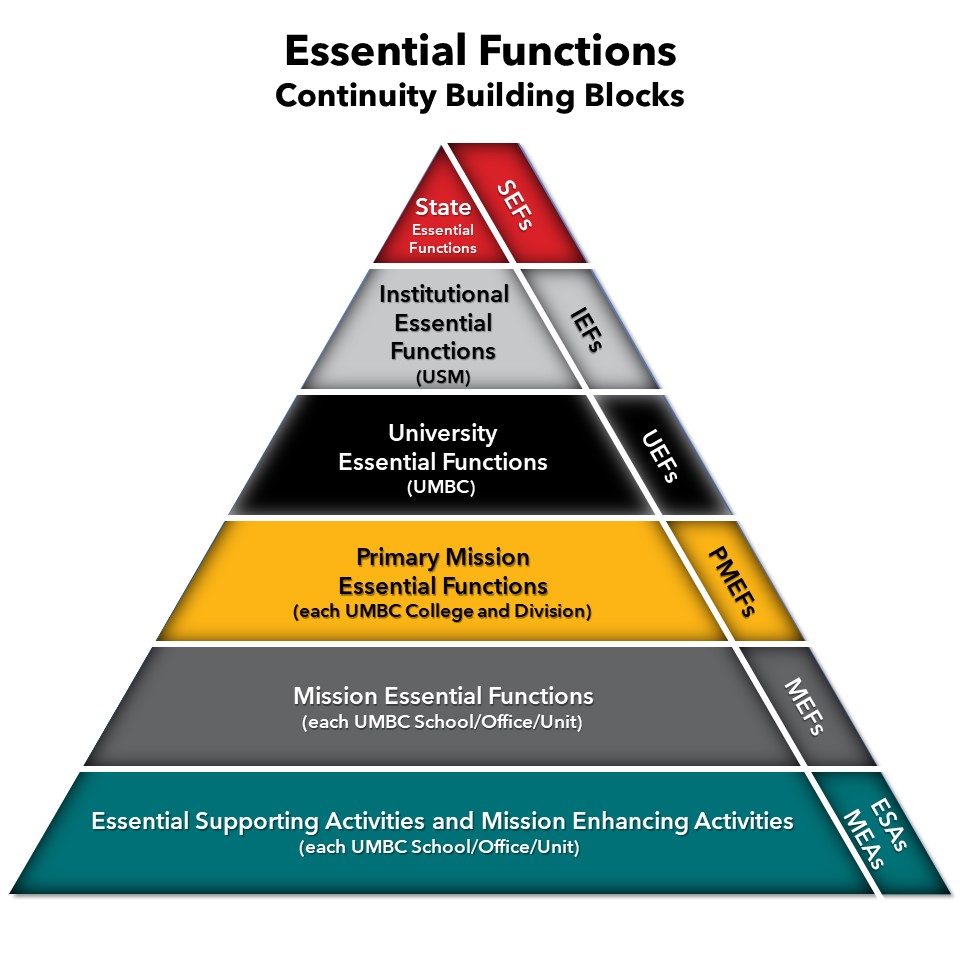
Essential Functions are the building blocks of continuity.

Each set of functions is supported by the ones below.  The Maryland COOP Guide for State Agencies describes State Essential Functions.  The University System of Maryland (USM) may develop Institutional Essential Functions (IEFs).  UMBC’s essential functions align with these and include:

  • University Essential Functions (UEFs)
  • Primary Mission Essential Functions (PMEFs)
  • Mission Essential Functions (MEFs)
  • Essential Supporting Activities (ESAs) and Mission Enhancing Activities (MEAs)

Click on the graphic to the left to see each level.  The tabs below provide descriptions for each category.

University Essential Functions (UEFs) form the basis for all our continuity decisions.  These are the responsibilities of the University necessary to sustain our existence as an institution of higher learning.  Our UEFs mirror the five strategic pillars detailed in the UMBC Strategic Plan.

  • UEFs are the primary focus of the President and senior leaders before, during and after disruptions.
  • UMBC must successfully maintain our UEFs at all times, and especially during emergencies.
  • The objective of each College and Division is the continuation of our five UEFs.

UEF 1

Innovation & Vitality.  Embrace a workplace culture of continuous improvement and innovation, investing in the future by investing in our people and an environment that is inclusive and welcoming for all.

UEF 2

Research & Creative Achievement.  Set new standards for research and creative excellence as an R1 institution, building an inclusive, transdisciplinary, and translational enterprise that advances scholarship, discovery, understanding, and innovation across all fields, and contributes to economic prosperity, cultural vitality, and the public good.

UEF 3

Strengthen Maryland & its Communities.  Deepen reciprocal collaborations and engagement with our neighboring communities and partners in education, arts, government, civic organizations, and industry; contributing to the state’s well-being and capacity to thrive.

UEF 4

Student Opportunity & Success.  Lead in advancing student opportunity and success by expanding access, strengthening high-impact programs and supports, and creating new pathways to improve the student experience and post-graduate success.

UEF 5

Teaching & Learning.  Lead the nation in pedagogical excellence through innovative and evidence-based practices that educate students for inclusive collaboration, meaningful careers, civic responsibility, critical navigation of emerging technologies, and lifelong learning.

Each College and Division has its own Primary Mission Essential Functions (PMEFs).  They are services that directly support continuation of one or more UEF.

  • PMEFs must remain continuous OR resumed within 12 hours after disruption.
  • PMEFs must be maintained up to 30 days during disruption OR until normal operations resume.

Each school and office within a College or Division has its own Mission Essential Functions (MEFs).  These are services that directly support continued performance of one or more PMEF.

  • MEFs are a limited set of organizational work function that provide vital services to our community.
  • Departments must continue their MEFs throughout a disruption, or resume them rapidly after a disruption.

Essential Supporting Activities (ESAs) are functions that support the performance of MEFs.  MEFs may be supported by multiple ESAs. 

  • ESAs may have a mandate, policy, regulation, or legal requirement.
  • ESAs are important activities…however, performance of ESAs alone does not accomplish your mission.
  • ESAs must remain aligned to a single MEF, though different MEFs may have similar ESAs.

Mission Enhancing Activities (MEAs) compliment a MEF or an ESA.  They are products of best practices, established customs or traditions, or industry recommendations.

  • MEAs DO NOT have a mandate, policy, regulation, or legal requirement.
  • Expect to defer MEAs during a disruption and communicate this expectation to your partners, customers, and stakeholders.

Continuity planning is a continuous processes that must be championed by senior leaders and detailed by subject matter experts.

  • Senior leaders define our University Essential Functions (UEFs).
  • Colleges and Divisions define their Primary Mission Essential Functions (PMEFs).  Each PMEF must directly support at least 1 UEF.
  • Individual units determine their Mission Essential Functions (MEFs).  Each MEF must directly support at least 1 PMEF.  Units also separate Essential Supporting Activities (ESAs) from Mission Enhancing Activities (MSAs).
  • Individual units identify and group their organizational work functions.
  • Your Emergency Manager directs the process and merges these objectives into the University COOP.

There are 4 Phases of Continuity Planning:  Phase 1:  identify your organizational work functions.  Phase 2:  conduct a Business Process Analysis (BPA).  Phase 3:  conduct a Business Impact Analysis (BIA).  Phase 4: prioritize and document essential functions.

The first step in continuity planning is to identify your organizational work functions.  Use the links below to access your College or Division’s continuity survey.  Each survey allows a department to develop an inventory of all it’s work functions.  Survey questions allow staff to describe their primary day-to-day work functions in basic terms.  These are activities that are central to the performance of their job requirements.  Staff responses are captured in an online spreadsheet.  Leaders review and validate responses to identify gaps, expand on unique activities, and identify interdependencies that link functions together.  This creates “buckets” based on common themes, and we use these buckets to develop Mission Essential Functions (MEFs).

A Business Process Analysis (BPA) is a systematic method of examining, identifying, and mapping the functions needed to perform each Mission Essential Functions (MEF).  This identifies gaps in your department’s inventory of organizational work functions from Phase 1 and details areas where multiple offices share responsibilities.

A Business Impact Analysis (BIA) predicts the consequences of a disruption to business operations.  It calculates operational, financial, compliance, and reputational costs of downtime. A BIA also establishes three specific performance targets for recovery: 

1)  Max Tolerable Downtime (MTD):  The maximum amount of time acceptable for a disruption of MEF performance.

2)  Recovery Time Objective (RTO):  The maximum acceptable length of time a MEF can be down before severe harm is sustained.

3)  Recovery Point Objective (RPO):  The maximum acceptable amount of resource loss measured in time.

  • Business Impact Analysis (BIA) WorksheetComing Soon

Each College and Division may maintain an individualized Department Emergency Action Plan (DEAP) for continuity.  Subordinate units within the College or Division may also have a DEAP.  Each DEAP describes a College or Division’s PMEFs and lists each subordinate unit that has its own plan.  These plans document the continuity process, to include BPAs and BIAs, and describe your Emergency Action Procedures (EAPs).  EAPs are the immediate actions taken during a continuity disruption to mitigate impacts on operations.  EAPs are short checklists that simplify procedures. EAPs state no more than five immediate actions used to mitigate impacts: 1) detect; 2) verify; 3) notify; 4) act; and 5) end (or restart at step 1).

  • Department Emergency Action Plans – Coming Soon
  • Emergency Action Procedure template – Coming Soon